Becky Pobst is the Director of Forestry at Friends of Grand Rapids Parks. She’s passionate about teaching people how to engage with their trees, tree research, and building community. We caught up with her about how she got into urban forestry, what goes into making a street tree happy and healthy, and her dreams for the future of Grand Rapids’ urban forest.
Friends of Grand Rapids Parks: What got you interested in forestry? You didn’t start out in this field.
Becky: No, I didn’t. Like a lot of people who end up in forestry, it’s my second career. My first career was in animation!
I lived in LA for 10 years when I worked as an animator. My neighborhood had one palm tree and a lot of dead grass. I’d be irritable and exhausted walking home from the subway. But, if I went one mile to the east, the neighborhood had nice trees, grass, and parks. In that nice neighborhood, people were out jogging…there was a huge difference in the environment. That was my first introduction to the effects of urban forestry.
Whenever I needed a break from LA, I’d go to Sequoia National Park. Once when I was there, I ran into a forester working on a controlled burn, and that was my first time understanding that fire is a necessity for most forests. He talked to us about why it was helpful and that conversation sparked my interest in ecology.
Friends: What inspired you to transition from animation to forestry?
Becky: After 10 years of working in LA, I started to miss my family and Michigan. There aren’t really the same opportunities to work in animation in the midwest, so I knew I’d have to transition careers, which was fine, because I realized my primary creative outlet couldn’t be my main source of income.
My parents had a five-acre wooded lot, and a forester came out and gave them a management plan. I realized I could have a job talking about trees all day. I applied to a program at MSU thinking I’d be working in rural forests. I took one class on urban forestry, and was hooked.
Friends: Are there any overlaps between your creative, animation work and forestry?
Becky: Yes! I was really surprised at how many skills transferred when I went back to forestry school. Having a visual background made learning to identify trees really easy. Art is really just another form of science—the ability to record observations.
I’m also pretty good at measuring things by sight because of training in perspective drawing. In animation, we had to be able to communicate without language, which makes me think about the info we put out to our community and how to minimize any barriers to understanding, which is especially important in urban forestry.
Friends: Can you tell us a little more about urban forestry?
Becky: An urban forester looks at the health of all the trees in the city. It’s taking a holistic approach to treating trees as part of the city’s green infrastructure—how they interact with utilities, how they interact with us, and being strategic about maximizing the benefits.
An urban environment is not a native environment. Most tree species we plant are native, but not all native trees will do well in an urban setting, so we bring in trees that are not native, but not invasive. We look at how they reproduce, look at their form, any hint they become invasive. The City has an approved species list they put a lot of work into. Trees on this list have features like longer growing seasons that will help them survive in a tough environment like a city.
Friends: Can you tell us about what you do as an urban forester?
Becky: Part of my job is that I need to plan for problems that don’t exist and might not exist for 100 years. In my time at Friends, I’ve learned a lot about species selection and what will do well in an urban environment in the future.
Friends: What motivates you to work in urban forests and care for urban trees?
Becky: I always joke, I’m a redhead so the more shade the better. That’s why I’m doing it!
In all seriousness, I’ve experienced firsthand the difference in how I feel when I live in a space with a lot of trees versus no trees. Scientists also notice a strong connection between neighborhood trees and a better life, and I want that for everybody.
Friends: I hear you’re planning a pretty special event…tell me about ArborFest!
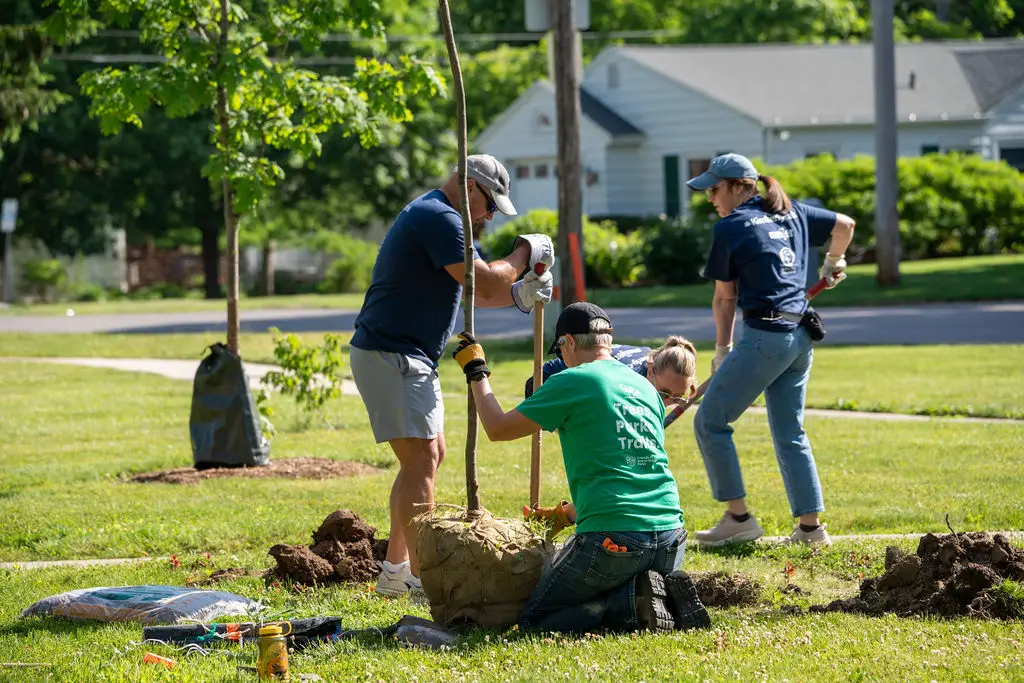
Becky: ArborFest is everything I love about my job all crammed into two days. It’s such a fun way to start the planting season for our team. The community shows up, we have a party in a park, and we plant a ton of trees. Residents come out all the time to chat as their tree is being planted, which I love. Then, after we go out with our youth green team and water trees, too. It’s a good day to be part of a community.
Friends: What else are you looking forward to this year?
Becky: I am looking forward to being back in Garfield Park! We haven’t planted there since 2020. We were just out taking care of trees we planted six years ago and I almost didn’t recognize them because they’ve gotten so big. Some neighbors decorate their trees and it makes me so happy to plant trees alongside trees from a few years ago.
Friends: What question do you wish you were asked? About forestry, trees, or urban forestry.
Becky: I love talking about trees and forestry, so I love every question I get. I even appreciate when people ask tough questions, like when they’re concerned about the trees that don’t survive, or why we don’t exclusively plant native trees. They are so many factors that make urban life so difficult for our trees, and I really appreciate every opportunity I get to discuss it with the people who share space with them.
Friends: Oh, what makes an urban environment difficult for trees?
Becky: The soil is more compacted than it would be in forests, and there’s a lot of concrete that makes it difficult for trees to grow in.
Salt spray from roads in the winter is also hard on trees. Salt spray can travel up to 50 feet from roads. That gets into the soil and their ability to take up nutrients. Air pollution is not native and puts extra stress on trees. Flooding events can be tough on trees. Even heat and reflecting buildings can increase temperatures and a lot of trees aren’t built to live in that environment. A lot of trees can’t swing between extremes like in Michigan with very cold and very hot. Trees can create their own micro environments and reduce the extreme swings. We keep trying for tough areas because it makes it better for other trees.
Friends: There’s so much that goes into just planting a tree! Thank you for all your work.
Becky: It’s my pleasure! When I do my job really really well, no one will know. 100 years from now, no one will think about that tree, they’ll just enjoy it, not think about how it got there. I love knowing I have a hand in creating that kind of future of Grand Rapids.