Melanie Manion is the Conservation Manager at Friends of Grand Rapids Parks. She’s a passionate advocate for conservation, education, and inviting the community to steward public lands together. We caught up about her conservation origin story, what drives her love of education, and what she’s working on at Friends.
Friends: Hey! Thanks for sitting down with us.
Melanie: My pleasure! I’m always excited to talk about conservation.
Friends: How long have you been doing conservation work?
Melanie: 30 years!
Friends: What got you interested in conservation?
Melanie: When in my senior year of getting my undergraduate degree in biology, I learned acorns turn into oak trees. I realized I had a gap in knowledge of the world around me. I was getting a degree to protect the environment but I didn’t know what was in the environment.
Then I took an ornithology class and I went from knowing three birds to 360 birds. And that blew my mind. I was walking by these things the whole time and never knew they were there. It was an awakening. I realized I wanted to help other people learn about what’s happening around them and why we need to start caring for it. I felt like if I was in that position walking around not knowing, there were a lot more people in that position.
Friends: So why does conservation matter? Why should we start caring for it?
Melanie: There’s the simple version: western science teaches us about the importance of the ecological services they provide. Ecological services are the direct and indirect benefits that ecosystems provide humans. We know our health declines as our environment declines. Less contact with the natural world means worse health outcomes. Conservation also means cleaner water, cleaner air—all that stuff.
Friends: You also talk about being outside doing conservation work being good for mental health.
Melanie: Absolutely. It’s the personal component. I believe that we heal ourselves when we heal the world around us. There’s a relationship there. When we take care of the earth, it takes care of us.
Friends: What positive changes have you seen conservation accomplish?
Melanie: I was fortunate to work with every 6th grader in Grand Haven for 12 years. One of the groups of kids I was working with had a lot of energy—I was told they were difficult. Fortunately, high-energy 6th graders are a lot like a herd of bison that would have kept areas open in West Michigan, historically.
I found a spot with indicators it could be restored, but people thought it was a wasteland. People asked me “why are you investing energy in this property?” but everyone deserves a chance to try. I set the high-energy kids free to pull spotted knapweed.
The next year, bastard pennyroyal, a threatened species of flower, came up where they pulled. It’s one of the only spots in the state where it grows. It was so amazing. Just by removing that invasive that was out-competing it (and by trampling the environment), the flower was able to come back.
Friends: That’s incredible!
Melanie: Can I tell you about another project?
Friends: Of course!
Melanie: We had a property that was flooding, so the drain commissioner wanted to put a drain through it. But, drains aren’t conservation-minded. We worked with them to do surveys to see what was out there, and we realized that there was a rare ecosystem called a coastal plain marsh. Coastal plain marshes include species from the Atlantic and Gulf of coasts.
We worked with them to create a drain that bent like a natural stream. We also created another spot that was deeper to protect the rare toads there. It was an unusual way to go about a restoration project.
It blew everyone’s mind, because the property, which was a dry red pine plantation, came back as a coastal plain marsh…but it came back in weeks. We managed to restore an immense new rare habitat and install a drain!
Friends: I’ve heard you say that conservation saves money. Did this project have financial benefits?
Melanie: Yes! Typically when people do these kinds of drain projects, they re-seed the area with grass. I did not want them to bring in seed. I let the area take care of itself. I also asked that they not use plastic erosion fabric, so they didn’t have to purchase that material.
Friends: That’s great that they trusted you to do something different.
Melanie: I was so grateful they wanted to work with me and take the risk.
Friends: So I hear you’ve been doing something cool here at Friends. Can you tell me about that?
Melanie: We just launched our Neighborhood Conservation program!
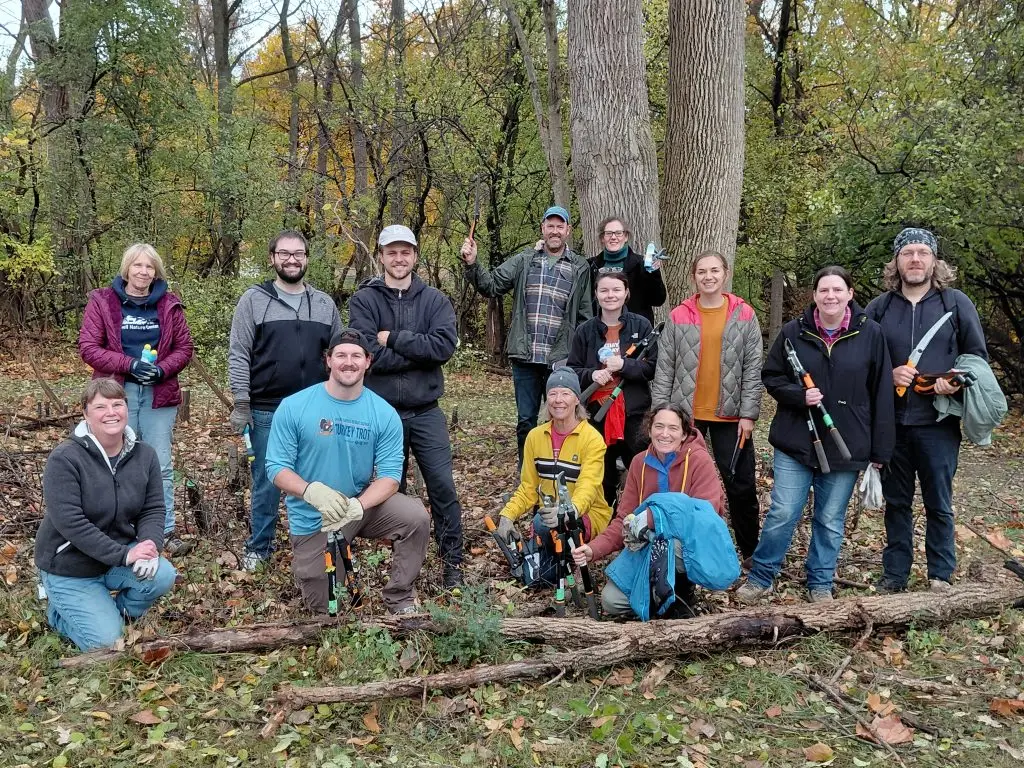
At every one of our work days, I had people saying “I want to do this on my own.” It was every work day people wanted to get out and keep working. This program gives people the tools and skills to do conservation work independently in Grand Rapids parks.
I’m training people in ecology, invasive species, how to remove them, and how to be safe in the field. It’s going to be a similar experience to the Neighborhood Forester program, and it’s really cool.
Friends: How did the Neighborhood Conservationist program idea come about?
Melanie: I’ve wanted to do this for 20 years. I’ve always wanted to build capacity to let volunteers work outside of our workdays. Working at Friends made it happen. Liz, our Volunteer and Community Outreach Coordinator, helped me do a risk assessment and organize resources. We’ve also had so much support from the City of Grand Rapids’ Parks and Recreation department. It feels like the stars just aligned.
Friends: What are you excited about with Neighborhood Conservationists?
Melanie: I’ve loved the community aspect of it. People get what I was trying to form, which is a group of likeminded people on the same team working on the same goal. It’s also so exciting to watch people grow, and to learn from them. As people grow, they start thinking and bringing what they learn back to me. The whole conservation community is growing together.
Friends: What do you see the future of conservation being for Grand Rapids parks?
Melanie: I also love watching the capacity for conservation grow. When you can only work during a workday, that limits how much work can be done. This program uncaps that potential. We’re setting the community up to grow park conservation work in our parks exponentially. In 10 years, it’s going to be a completely different park system.
Friends: What do you want people to know about making a difference in their local community?
Melanie: When you’re going through difficult times, working with people and building relationships is how we get through it. It doesn’t matter what you choose to do but caring for the community helps us understand how to work together to be more resilient.
Friends: That’s really beautiful.
Melanie: Well thanks!
Friends: Have any book recommendations?
Melanie: Up until recently, I hadn’t really read fiction. But I highly recommend the Firekeeper’s Daughter Series. I also recommend Braiding Sweetgrass and Bringing Nature Home.